
As electrification and connectivity sweep through industries—from automotive and mobility to medical and consumer electronics—the demand for reliability under tough environmental conditions grows. Whether it’s moisture, dust, chemicals, or extreme temperatures, sensitive components like PCBs and sensors need a protective shield. That’s where encapsulation comes into play.
Encapsulation explained
Encapsulation is a process in which one material is molded around another to provide protection. Sensitive electrical circuits (PCBs) and sensors are commonly encapsulated to safeguard them from environmental hazards, including moisture, chemicals, heat, dust, and mechanical shock. This protective layer enhances the durability and reliability of sensitive components in demanding conditions.
Transfer molding is a conventional method of encapsulation of electronic components. It is a process of encapsulating microelectronic devices in a closed mold using a thermosetting material that is transferred under pressure by using a plunger. Important requirements are good adhesion to the base materials, low viscosity, good dimensional stability, and high chemical resistance.
Epoxy Molding Compounds (EMCs) fall into the category of thermosetting materials and are commonly used in various applications because of their physical properties. Known for their versatility and robustness, EMCs are a mainstay in a multitude of industrial products, from highly advanced automotive and aerospace parts to electrical and electronic implementations.
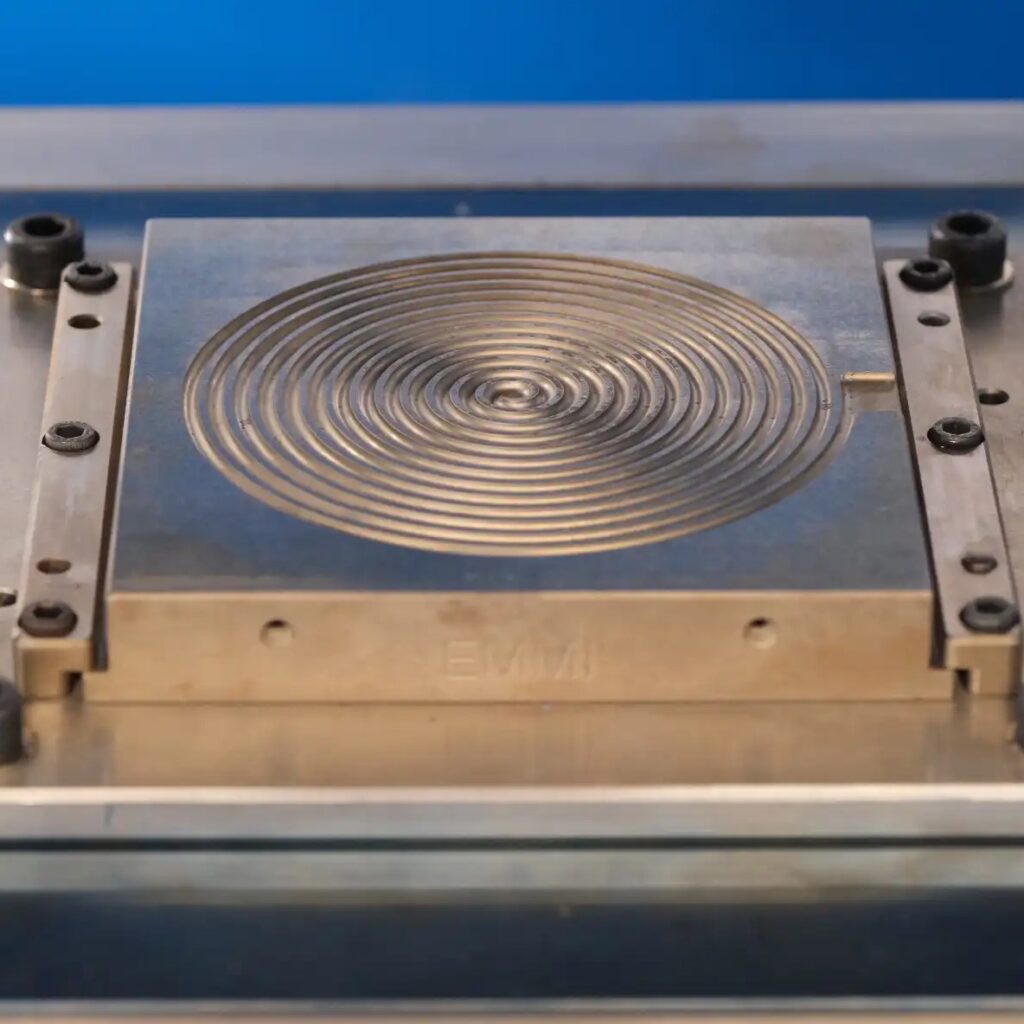
EMCs have attained dominance among the common materials due to their excellent properties that can be altered by adding different fillers. As failure is not an option, testing is essential. The influence of the fillers on the compound materials can be determined with e.g. the spiral flow length (EMMI Spiral Flow). But how do you ensure these materials perform consistently?
Spiral flow testing according to ASTM D3123
This is where spiral flow testing, as described in ASTM D3123, becomes essential. For encapsulation or other low pressure molding techniques, this test method describes a procedure for measuring the spiral flow of thermosetting molding compounds (soft or very soft). It involves the use of a standard spiral flow mold in a transfer molding press under specified conditions of applied temperature and pressure with a controlled charge mass.
The spiral flow of a thermosetting molding compound is a measure of the combined characteristics of fusion under pressure, melt viscosity, and gelation rate under specific conditions.
It’s a valuable quality control tool—both for verifying material consistency and for acceptance testing in R&D and production settings.
The Fontijne Presses dedicated lab press
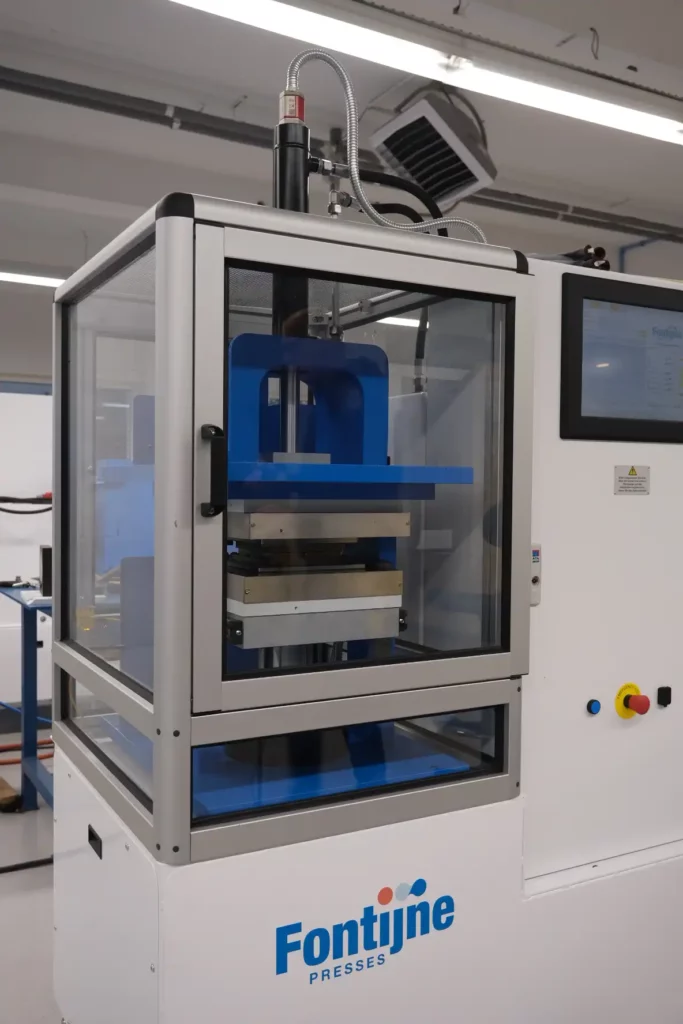
Fontijne Presses has taken spiral flow testing to the next level and has developed a special transfer molding press meeting the specifications as described in the ASTM D3123 standard.

Key features at a glance
- Heated platens: Two steel platens (320 x 320 mm) that can reach a maximum temperature of 300°C, with a ramp-up speed of 20°C/min.
- Hydraulic force: Up to 150 kN on the press platens, sufficient clamp pressure to prevent flashing, and 50 kN on the plunger—precisely servo-controlled for accurate pressure application (10.7±0.2 kN) based on a calculation of the transfer pressure (6.90±0.17 MPa) and a pot diameter of 44.45 mm according to ASTM D3123.
- Complete tooling: Includes an EMMI Spiral Flow mold plate (exchangeable by means of 2 guiding blocks) with plunger, guiding bush, upper and lower plates—all ASTM D3123 compliant.
- Safety and efficiency: Features a safety cage with sliding door, integrated waste bin, and a smooth workflow.
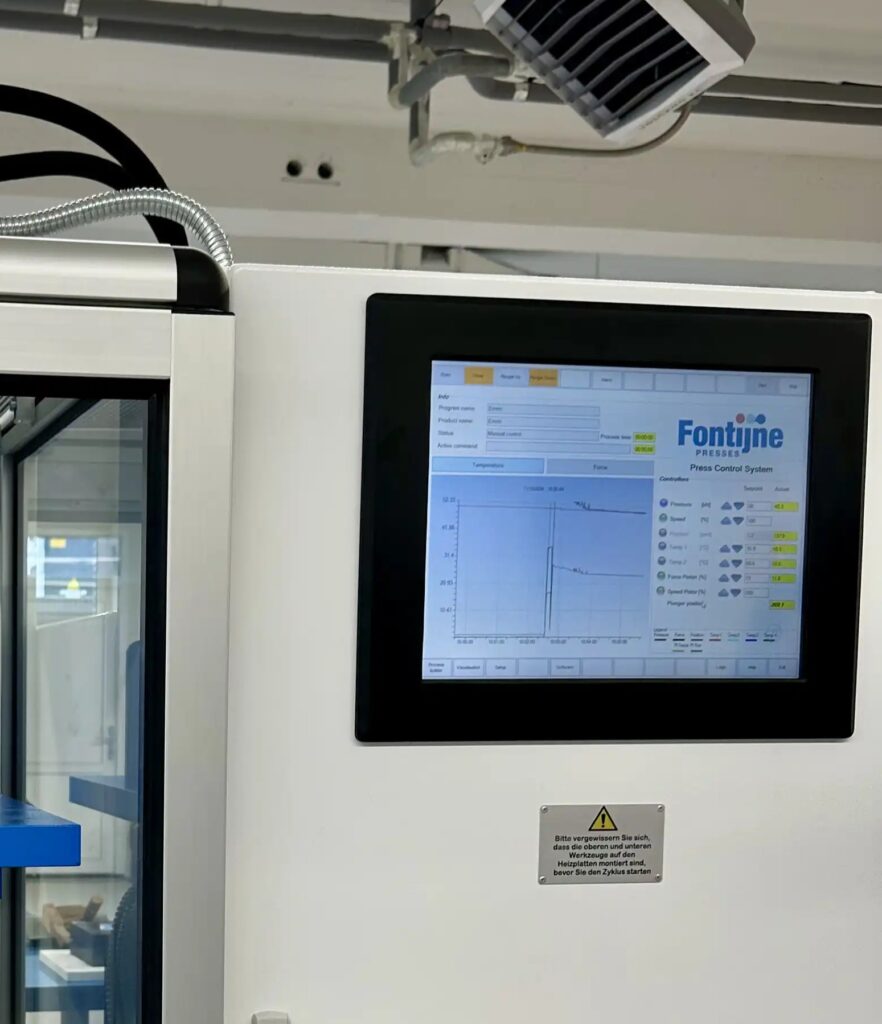
- Smart control: ProView 15” touchscreen interface for full cycle control, intuitive settings, and real-time process visualization.
- Optional add-ons: External thermocouples programmable via the touchscreen.

How it works: Step-by-step procedure
- Close the mold and move the plunger to the end position.
- Heat the mold to 150±3°C and wait for the temperature to stabilize.
- Clean the plunger sealing grooves before each molding.
- Weigh the compound to the nearest 0.1g.
- Reset the plunger to the start position.
- Fill the compound in the transfer pot and activate the cycle immediately.
- Cure the compound.
- Open the mold and remove the molded sample.
- Read the spiral flow length directly from the molded specimen at the point of farthest continuous flow to the nearest 0.25”.
- Repeat these steps until three consecutive flow readings are within ±5% of the average.


Built for the future of materials testing
With over 2,000 laboratory platen presses installed worldwide, Fontijne Presses is a trusted name in precision molding and testing equipment. Their custom-engineered transfer molding press ensures that your encapsulation materials meet the highest standards—batch after batch.
So, whether you’re developing next-gen automotive electronics or pioneering smart medical devices, this press is ready to deliver.
Interested in this solution?
Contact our team to learn how the Fontijne Presses transfer molding press can support your material testing and quality control process. We’re here to help you.